

The iPad 3
Gruber writes about the AP's suggestion that the iPad 3's specs indicate a “modest upgrade:”
I suspect this is a prelude to much of tomorrow's post-event coverage, echoing the initial tech press reaction to the iPhone 4S. But if a faster processor, more RAM, a double-the-resolution retina display, a better camera, and maybe even LTE networking make for a “modest” update, then what would it take for the iPad 3 to be deemed an immodest update? A fusion energy source? Teleportation? A camera that sees into the future?
I Had My Cake and Ate It Too
I had to share this here for my friends who are not on Facebook. This is the beautiful cake that was served last night at the reception after my ordination.
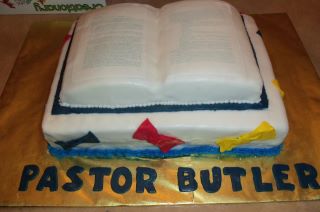
UPDATE: I should have explained it a bit since the picture I posted here is too small to see the details. The book on top is the Book of Church Order for the Presbyterian Church in America, turned to chapter 21, the chapter concerning “the ordination and installation of ministers.” The bow ties adorning the sides are there since I am known to frequently wear bow ties at church. Joyce, my friend from Grace who made the cake, really outdid herself!
Ordained
My ordination and installation service was tonight. I'll need to write on it, hopefully tomorrow. I am amazed by all of my family, friends and church family that were there tonight and how encouraging they were. What an incredible blessing.
Love
George Herbert is a fascinating poet and one of the best examples of the Metaphysical Poets. “Love” is one of his most poignant pieces of poetry:
Love bade me welcome; yet my soul drew back,
Guilty of dust and sin.
But quick-eyed Love, observing me grow slack
From my first entrance in,
Drew nearer to me, sweetly questioning
If I lack'd anything.
'A guest,' I answer'd, 'worthy to be here:'
Love said, 'You shall be he.'
'I, the unkind, ungrateful? Ah, my dear,
I cannot look on Thee.'
Love took my hand and smiling did reply,
'Who made the eyes but I?'
'Truth, Lord; but I have marr'd them: let my shame
Go where it doth deserve.'
'And know you not,' says Love, 'Who bore the blame?'
'My dear, then I will serve.'
'You must sit down,' says Love, 'and taste my meat.'
So I did sit and eat.
25. Billion.
It seems the the App Store has reached 25 billion downloads. It is hard to even recall the days long past where people questioned whether the App Store could even succeed. It may not be perfect, but I've never seen another form of application distribution that makes getting the apps everyone actually wants so easy.
Lutheran Insulter
No, this? is not a site to insult your favorite Lutheran friends with. Rather, it is the tool you need when what you need is a really good insult. Why? Because few have approached the level of mastery of this art that Martin Luther did and now you can receive random insulting goodness from the man Calvin called the Apostle of the Reformation whenever you want.
This is too much fun.
Leaping into Asisaid's Second Decade
I managed to overlook my blog's anniversary, February 21, which marked my tenth year of blogging. Given that I missed that date, it seems the second best option is to commemorate that milestone by mentioning it on Leap Day. The blogosphere has certainly changed since I first started writing here and I think services like Facebook have drained some of the life out of blogs. Nevertheless, I still find the whole blog concept intriguing and worth continued exploration.
I hope everyone had a good “extra day”!
Next Week's Apple Event
The invitation seems to give it away. If anyone had any doubt, it looks like the iPad 3 will have a Retina Display. The big question is what else will be new — I'm betting on a hefty processor upgrade to help drive the significantly higher resolution display.
Boot2Gecko
This looks interesting, though I can't help but wish they were announcing their support for Open webOS instead. WebOS is so good, if the FOSS community really wants to take iOS head on, that's the way to do it.
Grace Annual Talent Show
We had our annual talent show tonight at church. The show, dinner and silent auction serve to raise funds for the youth group's summer trips, which, in itself, is a worthy goal. But, also worthy is just how delightful it is for the portion of the body of Christ placed in this little church to get to spend time laughing together. The event is never anything close to dull! I'm looking forward to next year's show…