


My Desktop from Ten Years Ago
I ran across this screenshot today and thought it was interesting. This is what my desktop on my computer looked like ten years ago.
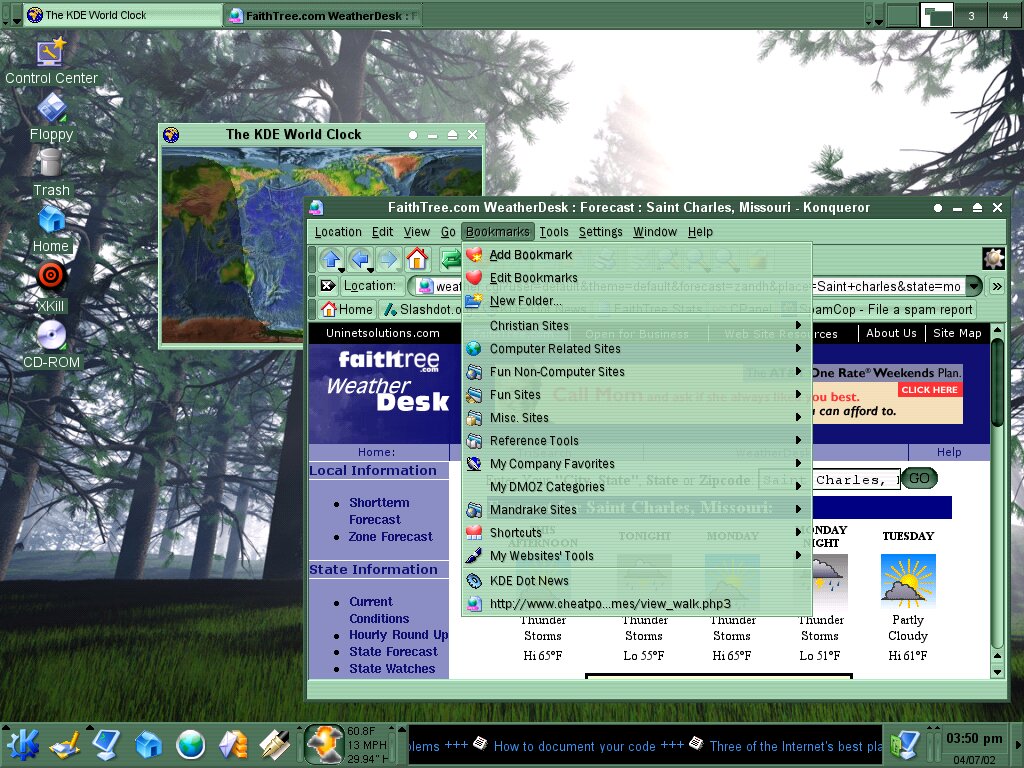
Interfaces have definitely improved since then.
Are these Legal Aliens?
An interesting set of survey results from National Geographic:
Nearly two in three Americans think President Barack Obama is better suited than Republican rival Mitt Romney to deal with an alien invasion, according to a survey released Wednesday.
Good to know.
The Danger of Online Reporting
Gruber writes about how Gizmodo managed to report as current news information it had gathered from an article published in late 2011:
Follow that link to the purported source, though, and it comes up as an empty web page. I think, though, it was the mobile URL for this story, published by the same reporter (Cromwell Schubarth) for the same publication (The Puget Sound Business Journal). The problem for Gizmodo: the dateline for that story was September 2011.
Since the article makes a big deal about what is not going to happen “this year,” it is incredibly important that the source story's “this year” was 2011 and not 2012. This is the bad side of reporting that comes out of blogs: sometimes even the biggest and best draw off of other sources without bothering to complete even a modicum of research.
Late Night Haiku XLIV
CXXV. The dark night crept around
The window panes, curled about,
And settled inside.
CXXVI. Kalmar now contains
A secret which hides about,
One foot around it.
CXXVII. What is to be told,
And what has been told so far —
Neither are so clear.
Waiting for the Court
The Washington Post has a nice piece from Robert Barnes, examining the state of the Supreme Court's decisions on cases defended by the Obama administration. He notes some interesting currents in the court:
But whatever the reasons, the losses so far cannot be blamed on the conflict between an increasingly conservative court and a progressive administration. For instance, the authors of the Indian cases that went against the government last week were Justices Sonia Sotomayor and Elena Kagan, Obama's choices for the court.
Memory Lane
When you've been blogging for ten years, one's blog tells something about one's life. I happened to be trying to look up something today and ended up on Archive.org's Wayback Machine. On a whim, I typed in asisaid.com and went on a stroll down memory lane. While I can view any of the posts from asisaid's 10+ years of history directly on this site, there is something interesting about seeing them in their original form, complete with whatever now dated looking theme I had on the site at that time the post originally appeared. I found myself reminded of old blogging and real world friends I have lost touch with, and others that I have not. I also found it interesting seeing what it was I was contemplating then that no longer seems important contrasted with matters that I am still thinking about, working on or otherwise processing.
Some might suggest (and, perhaps, for good reason) that the archiving of everything that goes online can be a curse. If one is careless in what one places online, it certainly will prove to be. On the other hand, with a dab of commonsense applied, services such as the Wayback Machine actually show the value of the archival abilities of the digital age: the ability for everything to exist in something of a virtual time capsule, available for us to learn from and enjoy.
Drudging the Headlines
Depending on how you look at it, Matt Drudge either posted one of his best or worst headlines today. Earlier, the Drudge Report had a large headline that said “GREEKS KICKED OUT OF EURO!” Naturally, I assumed that the Eurozone had ejected Greece from the multinational currency system and went to read the news. The actual article, however, was about soccer. Hmm.
Microkia
Gruber quoth:
If I'm right, it's inevitable now that Microsoft will acquire Nokia.
I think he is right. It doesn't really make sense for Microsoft to target the tablet space with its own, tightly controlled product line and ignore the cell phone market. The two markets clearly feed off each other and, assuming the Surface does well, it will do well in stark contrast to the dismal sales record of Windows Phone 7. While the Zune fiasco shows that Microsoft can fail with hardware, the Xbox 360 is a good argument that Microsoft can also do quite well with its own hardware. Acquiring a company that is acting idiotically, but yet also brings major cell phone design talent with it, would be a good choice if Microsoft wants to make a massive first party splash into the mobile world.
Money Well Spent?
The ever interesting Larry Ellison seems to have made a most unusual purchase:
Larry Ellison has closed a deal to buy most the Hawaiian island of Lanai for an undisclosed sum.
The Oracle chief executive as agreed to purchase 98 percent of the 141-square-mile island, Hawaii's sixth-largest by acreage, according to a statement issued today by the Hawaii governor's office
That's one way to ensure you end up with good neighbors.
Happy Summer!
This year, with as warm as the weather has been, it is hard to believe that summer hasn't already been “in session” for several months. It'll be interesting to see what the rest of the season holds in store for us.